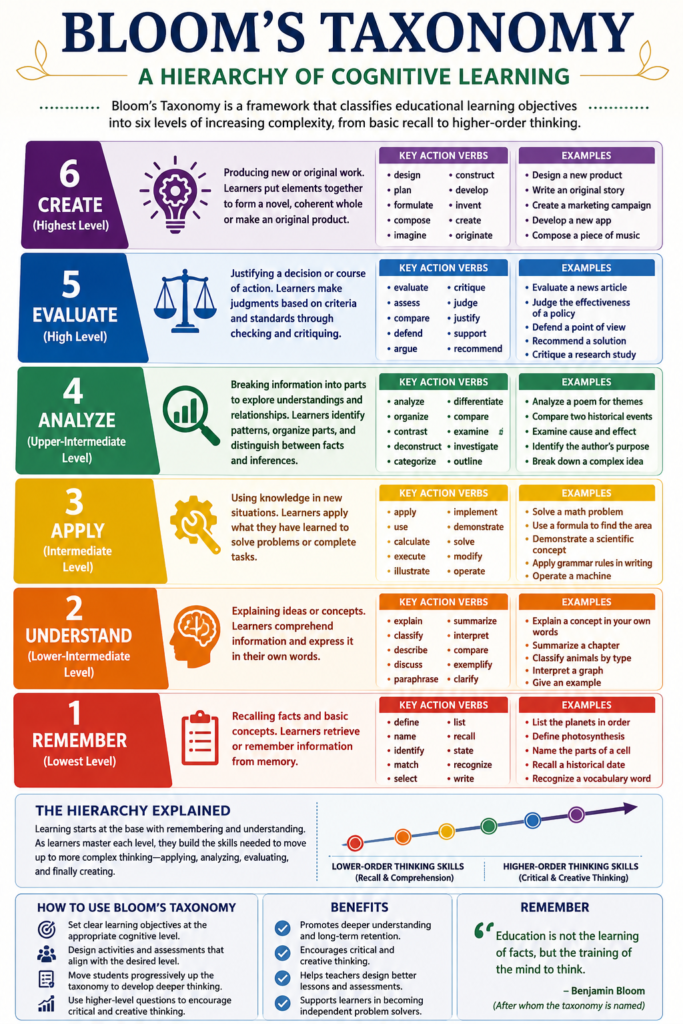
Bloom’s Taxonomy is the most widely adopted framework in education for classifying learning objectives, designing curricula, and measuring student achievement across cognitive, affective, and psychomotor dimensions.
What Is Bloom’s Taxonomy? Foundational
Bloom’s Taxonomy is a hierarchical framework for classifying educational goals and learning outcomes. Developed in 1956 by educational psychologist Dr. Benjamin Bloom and his collaborators — Max Englehart, Edward Furst, Walter Hill, and David Krathwohl — it was formally published as Taxonomy of Educational Objectives. The primary intent was to shift instruction beyond rote memorization toward higher-order thinking skills such as analysis, synthesis, and evaluation.
The taxonomy is most widely applied in designing educational programs, writing measurable course objectives, developing assessments, and structuring training processes across K-12 and higher education settings.
Key Insight
The three learning domains — often abbreviated as KSA (Knowledge, Skills, Attitudes) — correspond directly to Bloom’s Cognitive, Psychomotor, and Affective domains respectively.
The Three Domains of Learning
The committee identified three distinct domains of educational activity:
Cognitive Domain
Mental skills and intellectual development. Classified by Benjamin Bloom (1956). Covers knowledge recall through complex evaluation.
Affective Domain
Emotional growth, attitudes, values, and interests. Classified by Krathwohl (1964). Ranges from passive awareness to internalized values.
Psychomotor Domain
Physical and motor skill development. Classified by Simpson (1972). Covers perceptual readiness through creative origination.
Although the original committee produced detailed taxonomies for the Cognitive and Affective domains, they acknowledged a gap in the Psychomotor domain — attributing it to limited experience with manual skill instruction at the college level. This gap was later addressed by independent researchers including Simpson, Dave, and Harrow.
What are the Educational Objectives of Bloom’s Taxonomy?
The educational objectives of Bloom’s Taxonomy describe the specific learning outcomes educators expect students to achieve during instruction. These objectives help teachers structure lessons, organize classroom activities, create assessments, and measure academic progress systematically. Rather than focusing only on memorization, Bloom’s framework encourages the development of intellectual ability, emotional maturity, and practical performance skills.
Developed by Dr. Benjamin Bloom and his associates in 1956, Bloom’s Taxonomy classifies educational goals into three major domains of learning: the Cognitive Domain, the Affective Domain, and the Psychomotor Domain. Together, these domains provide a complete model for understanding how students learn knowledge, develop attitudes, and acquire skills.
Why Educational Objectives Matter
Educational objectives clarify what learners should know, understand, value, and perform after completing a lesson or educational program. They also guide teachers in selecting teaching strategies and assessment methods.
The Cognitive Domain: Original & Revised Taxonomy
The cognitive domain addresses intellectual skills — the capacity to recall facts, comprehend concepts, apply knowledge, and generate new ideas. It is the most referenced of the three domains in academic settings.
Original Taxonomy (1956) — Six Cognitive Levels
Bloom’s original cognitive framework presents six hierarchical categories progressing from simple recall to complex judgment:
| Level | Core Definition | Sample Action Verbs |
|---|
| 1. Knowledge | Recall of specific facts, methods, patterns, and structures. | define, list, recall, name, label, state, match |
| 2. Comprehension | Understanding communicated material; grasping meaning without full implication. | explain, paraphrase, summarize, interpret, predict, illustrate |
| 3. Application | Using abstract knowledge in concrete or new situations. | apply, construct, solve, use, demonstrate, develop |
| 4. Analysis | Breaking communication into constituent elements to understand organizational structure. | analyze, differentiate, distinguish, compare, contrast, inspect |
| 5. Synthesis | Combining elements and parts to form a coherent new whole. | design, build, compose, create, formulate, plan |
| 6. Evaluation | Making judgments about the value or worth of material and methods. | judge, appraise, criticize, justify, evaluate, conclude |
Revised Taxonomy (2001) — Action-Oriented Framework Updated
In 2001, Lorin Anderson (a former student of Bloom) and David Krathwohl led a team of cognitive psychologists, curriculum theorists, and assessment specialists to revisit the cognitive domain. The revised edition — titled A Taxonomy for Teaching, Learning, and Assessment — made three prominent changes:
- Categories renamed using action verbs instead of nouns (e.g., Remembering replaces Knowledge).
- Synthesis was repositioned and renamed Creating, now occupying the highest level.
- Evaluation moved to the fifth level, below Creating.
| Level | Description | Key Verbs | Example Task |
|---|
| 1. Remembering | Retrieve previously learned information from long-term memory. | find, recall, define, identify, list | Recite the steps of a safety procedure. |
| 2. Understanding | Construct meaning from instructional material by interpreting, classifying, and paraphrasing. | summarize, explain, infer, predict | Rewrite a complex principle in one’s own words. |
| 3. Applying | Carry out or use a procedure in a given or novel situation. | use, calculate, solve, demonstrate | Apply statistical laws to evaluate test reliability. |
| 4. Analyzing | Break material into component parts and determine how parts relate to one another and to the overall structure. | categorize, compare, deconstruct, distinguish | Identify logical fallacies in a written argument. |
| 5. Evaluating | Make judgments based on criteria and standards through checking and critiquing. | judge, criticize, justify, appraise | Select and defend the most effective solution to a business problem. |
| 6. Creating | Put elements together to form a coherent or functional whole; reorganize into a new pattern or structure. | design, compose, construct, invent | Write a company operations manual or design a new system. |
Higher-Order vs. Lower-Order Thinking Skills
Lower-Order Thinking (LOTS)
Remembering · Understanding · Applying
These foundational levels build the knowledge base. They are essential entry points but insufficient on their own for deep learning.
Higher-Order Thinking (HOTS)
Analyzing · Evaluating · Creating
These advanced levels develop critical thinking, problem-solving capacity, and creative output — the skills most valued in professional and academic contexts.
The Affective Domain: Attitudes, Values & Emotional Growth
The affective domain, classified by Krathwohl, Bloom, and Masia (1964 / 1973), addresses emotional dimensions of learning — how learners internalize attitudes, develop personal values, and integrate those values into a coherent lifestyle. It is organized into five hierarchical categories, from the simplest receptive behavior to the most complex internalization.
| Level | Description | Key Verbs |
|---|
| 1. Receiving (Attending) | Awareness and willingness to pay attention to particular phenomena or stimuli. | acknowledge, listen, follow, attend |
| 2. Responding | Active participation; the learner reacts and engages with the phenomenon. | answer, discuss, perform, present, comply |
| 3. Valuing | Attaching worth or importance to an object, behavior, or phenomenon; ranges from acceptance to deep commitment. | appreciate, justify, propose, respect, share |
| 4. Organization | Comparing, relating, and synthesizing different values into a coherent personal value system. | compare, relate, synthesize, prioritize |
| 5. Characterization | The learner’s behavior is governed by an internalized value system; this becomes a defining characteristic of their identity. | act, display, influence, revise, verify, solve |
Practical Application
Affective objectives are critical in ethics education, professional development, and social-emotional learning programs. They answer the question: “How does the learner feel about or value what they have learned?”
The Psychomotor Domain: Physical Skills & Motor Development
The psychomotor domain covers physical movement, coordination, and motor-skill development. Skills within this domain are measured by speed, precision, distance, procedural adherence, and execution technique — from basic manual labor to advanced athletic or technical performance.
Simpson’s Psychomotor Taxonomy (1972)
Elizabeth Simpson organized the psychomotor domain into seven levels, progressing from basic perceptual awareness to creative origination:
| Level | Description | Key Verbs |
|---|
| 1. Perception | Using sensory cues to guide motor activity. | detect, choose, identify, differentiate |
| 2. Set | Mental, physical, and emotional readiness to act. | begins, shows, proceeds, volunteers |
| 3. Guided Response | Early learning stage involving imitation and trial-and-error. | copy, trace, follow, respond |
| 4. Mechanism | Intermediate stage; learned responses become habitual with growing proficiency. | assemble, fix, manipulate, organize |
| 5. Complex Overt Response | Expert, highly coordinated performance with minimal energy expenditure. | Same as Mechanism, with qualifiers: quickly, accurately, efficiently |
| 6. Adaptation | Well-developed skills modified to fit special or unexpected requirements. | adapt, alter, rearrange, revise |
| 7. Origination | Creating entirely new movement patterns to address a specific problem. | arrange, compose, create, design, originate |
Dave’s Psychomotor Taxonomy (1970)
R.H. Dave proposed a simpler five-level framework emphasizing skill mastery and naturalization:
| Level | Description | Key Verbs |
|---|
| 1. Imitation | Observing and replicating another’s behavior; quality may be low initially. | copy, mimic, replicate, trace |
| 2. Manipulation | Performing actions from memory or written instructions. | act, build, execute, perform |
| 3. Precision | Refining accuracy; performing a skill independently with high exactness. | calibrate, demonstrate, master |
| 4. Articulation | Coordinating a sequence of actions to achieve internal consistency and harmony. | adapt, combine, create, customize |
| 5. Naturalization | Mastery at an unconscious, automatic level — the skill becomes second nature. | create, design, develop, manage, naturally |
Harrow’s Psychomotor Taxonomy (1972)
Anita Harrow classified psychomotor behavior from involuntary reflex actions to expressive non-verbal communication:
| Level | Description |
|---|
| 1. Reflex Movements | Involuntary, unlearned reactions to stimuli. |
| 2. Fundamental Movements | Basic learned movements such as walking or grasping. |
| 3. Perceptual Abilities | Responding to visual, auditory, kinesthetic, or tactile stimuli. |
| 4. Physical Abilities (Fitness) | Stamina, strength, and agility needed to support complex skill development. |
| 5. Skilled Movements | Advanced, integrated movements used in sports or performance arts. |
| 6. Nondiscursive Communication | Expressing meaning through body language, gestures, and facial expressions. |
Action Verb Reference: Writing Effective Learning Objectives
Choosing the right action verb is the cornerstone of writing measurable, level-appropriate learning objectives. The following verb clusters correspond to each cognitive level of the original taxonomy:
Knowledge Level
definedescribefindidentifyindicatelabellistmatchnamerecallreciteselectstatewrite
Comprehension Level
comparecomprehendcontrastdemonstrateexplainillustrateoutlinepredictparaphrasesummarize
Application Level
applycalculateconstructclassifydeveloporganizesolvetestuseutilize
Analysis Level
analyzeassumecategorizebreakdowndiscriminatedistinguishexamineinferreasonseparate
Synthesis Level
buildcreatecombinecomposecompiledesignderiveformulateproduceplan
Evaluation Level
appraiseacceptrejectcheckcriticizeevaluateinterpretjustifyjudgerank
Objective-Writing Tip
Behavioral learning objectives must be observable and measurable. Vague verbs like “understand” or “know” cannot be directly assessed — replace them with specific action verbs from the appropriate level above.
SOLO Taxonomy: A Cognitive Alternative to Bloom’s Framework
In 1982, John Biggs and Kevin Collis introduced the Structure of Observed Learning Outcomes (SOLO) Taxonomy as a complementary alternative to Bloom’s Cognitive Domain. Rather than classifying the type of thinking required, SOLO measures the quality and complexity of a learner’s understanding at any given moment.
SOLO is hierarchical, objective, and applicable across diverse subjects and age groups. Educational researcher John Hattie — of Visible Learning fame — is a prominent advocate of SOLO for its capacity to enable student self-assessment and teacher feedback design.
The Five SOLO Levels
Pre-Structural
The learner has no relevant understanding of the task. Information received is disconnected and lacks meaning. This level is generally excluded from formal SOLO measurement but serves as a conceptual baseline.
Unistructural
The learner grasps a single relevant aspect of the task. Basic connections are made, but broader significance is not yet understood. Responses are concrete and one-dimensional.
Multistructural
The learner understands several relevant aspects independently, but cannot connect them into a coherent whole. Multiple facts are known, but their combined significance remains unclear.
Relational
Different aspects of knowledge are integrated into a unified structure. The learner can explain how each component contributes to the whole, demonstrating coherent, connected understanding.
Extended Abstract
The learner transcends the taught content, generalizing concepts to new domains and generating original ideas. They can conceptualize beyond the scope of instruction and propose novel frameworks.
Why SOLO Taxonomy Is Valuable for Educators
SOLO distinguishes between surface learning (memorization and recall) and deep learning (conceptual understanding and transfer). Key pedagogical benefits include:
- Enables students to self-assess their current understanding level and identify the next learning step.
- Helps teachers design intentional learning experiences calibrated to student readiness.
- Supports the development of clear success criteria that students can act on.
- Provides feedforward guidance — directing students toward what to do next, not just what they did wrong.
- Illuminates the difference between surface and deep understanding on a visible, shareable scale.
- Applicable across all subject areas and year levels without modification.
Hattie’s Simplified SOLO Framework
John Hattie adapted SOLO into language accessible for younger learners and classroom settings:
| Hattie’s Term | SOLO Equivalent |
|---|
| No Idea | Pre-Structural |
| One Idea | Unistructural |
| Many Ideas | Multistructural |
| Relate | Relational |
| Extend | Extended Abstract |
Applying Bloom’s Taxonomy to Course Objectives & Curriculum Design
Bloom’s Taxonomy is most powerfully applied when writing explicit, measurable course learning objectives — brief, actionable statements that describe exactly what students will be able to do at the end of a learning episode. Clear objectives benefit both instructors (by anchoring instructional decisions) and students (by setting transparent expectations).
The revised taxonomy’s shift from nouns to action verbs makes it especially practical for objective writing: each verb signals a specific, assessable cognitive behavior. For example:
- “Students will be able to recall the six levels of Bloom’s Taxonomy.” → Remembering
- “Students will be able to explain the difference between the original and revised frameworks.” → Understanding
- “Students will be able to design a lesson plan that integrates HOTS objectives.” → Creating
Curriculum Design Principle
Effective course design — known as constructive alignment — ensures that learning objectives, instructional activities, and assessments all operate at the same taxonomic level. A Creating-level objective must be supported by Creating-level tasks and assessed with Creating-level criteria.
Bloom’s Taxonomy MCQs for FPSC PPSC Lecturer Assistant Professor SST EST
A)
Benjamin S. Blooms
B)
Simpson
C)
Krathwal
D)
Burner
The affective domain was classified by David Krathwohl, focusing on emotions, attitudes, values, and how learners internalize beliefs and responses.
Bloom’s Taxonomy MCQs for FPSC PPSC Lecturer Assistant Professor SST EST
A)
Benjamin S. Blooms
B)
Simpson
C)
Skinner
D)
None of the above
The psychomotor domain was classified by Simpson, focusing on physical coordination, motor skills, and practical performance development.
Ad
Adsense Ad Goes Here to support creaters.
Bloom’s Taxonomy MCQs for FPSC PPSC Lecturer Assistant Professor SST EST
A)
Attending → Responding → Valuing → Organization → Characterization
B)
Responding → Attending → Organization → Valuing → Characterization
C)
Attending → Valuing → Responding → Characterization → Organization
D)
Valuing → Responding → Attending → Organization → Characterization
The affective domain progresses from awareness to internalized values in this sequence: Attending, Responding, Valuing, Organization, and Characterization.
Bloom’s Taxonomy MCQs for FPSC PPSC Lecturer Assistant Professor SST EST
A)
Comprehension
B)
Application
C)
Knowledge
D)
Evaluation
Knowledge level involves remembering, memorizing, and recalling previously learned information without necessarily understanding or applying it.
Ad
Adsense Ad Goes Here to support creaters.
Bloom’s Taxonomy MCQs for FPSC PPSC Lecturer Assistant Professor SST EST
A)
Remember → Understand → Apply → Analyze → Evaluate → Create
B)
Remember → Apply → Understand → Evaluate → Analyze → Create
C)
Understand → Remember → Analyze → Apply → Evaluate → Create
D)
Remember → Understand → Analyze → Apply → Evaluate → Create
The revised Bloom’s Taxonomy follows a sequence from simple memory to creative thinking: Remember, Understand, Apply, Analyze, Evaluate, and Create.
Bloom’s Taxonomy MCQs for FPSC PPSC Lecturer Assistant Professor SST EST
A)
Comprehension
B)
Application
C)
Analysis
D)
Synthesis
Analysis involves dividing material into parts, identifying relationships, and understanding organizational structure to examine how elements connect.
Ad
Adsense Ad Goes Here to support creaters.
Bloom’s Taxonomy MCQs for FPSC PPSC Lecturer Assistant Professor SST EST
A)
Imitation
B)
Manipulation
C)
Precision
D)
Naturalization
Naturalization is the most advanced level in Dave’s psychomotor domain where skills become automatic, smooth, and habitual through mastery.
Bloom’s Taxonomy MCQs for FPSC PPSC Lecturer Assistant Professor SST EST
A)
Cognitive domain
B)
Affective domain
C)
Psychomotor domain
D)
None of the above
The psychomotor domain focuses on physical movements, motor skills, coordination, and practical actions requiring muscular activity and practice.
Ad
Adsense Ad Goes Here to support creaters.
Bloom’s Taxonomy MCQs for FPSC PPSC Lecturer Assistant Professor SST EST
Dave divided the psychomotor domain into five categories to explain the gradual development of physical and practical skills.
Bloom’s Taxonomy MCQs for FPSC PPSC Lecturer Assistant Professor SST EST
A)
1962
B)
1972
C)
1982
D)
1992
Simpson classified the psychomotor domain in 1972, presenting stages of motor skill development from perception to origination.
Ad
Adsense Ad Goes Here to support creaters.
Bloom’s Taxonomy MCQs for FPSC PPSC Lecturer Assistant Professor SST EST
Simpson divided the psychomotor domain into seven levels: perception, set, guided response, mechanism, complex overt response, adaptation, and origination.
Bloom’s Taxonomy MCQs for FPSC PPSC Lecturer Assistant Professor SST EST
A)
Application
B)
Knowledge
C)
Synthesis
D)
Comprehension
These verbs represent comprehension because they involve understanding, explaining, interpreting, and expressing ideas in meaningful ways.
Ad
Adsense Ad Goes Here to support creaters.
Bloom’s Taxonomy MCQs for FPSC PPSC Lecturer Assistant Professor SST EST
A)
Cognitive domain
B)
Affective domain
C)
Psychomotor domain
D)
None of the above
The affective domain deals with emotions, values, attitudes, interests, and feelings, shaping learners’ responses and personal development.
Bloom’s Taxonomy MCQs for FPSC PPSC Lecturer Assistant Professor SST EST
A)
Argue the point
B)
Recall the information
C)
Categorize topics
D)
Calculate distances
The knowledge level emphasizes recalling, recognizing, and remembering facts or information without deeper interpretation or analysis.
Ad
Adsense Ad Goes Here to support creaters.
Bloom’s Taxonomy MCQs for FPSC PPSC Lecturer Assistant Professor SST EST
A)
Remember
B)
Understand
C)
Apply
D)
Create
Create is the highest level in revised Bloom’s Taxonomy, involving producing new ideas, designing, inventing, or constructing original work.
Bloom’s Taxonomy MCQs for FPSC PPSC Lecturer Assistant Professor SST EST
A)
Attending or receiving
B)
Responding
C)
Valuing
D)
Organization
Organization occurs when learners arrange and integrate different values into a consistent system to guide decisions and behavior.
Ad
Adsense Ad Goes Here to support creaters.
Bloom’s Taxonomy MCQs for FPSC PPSC Lecturer Assistant Professor SST EST
A)
Two domains
B)
Three domains
C)
Four domains
D)
Five domains
Educational objectives are divided into three domains: cognitive for knowledge, affective for attitudes and emotions, and psychomotor for motor or physical skills.
Bloom’s Taxonomy MCQs for FPSC PPSC Lecturer Assistant Professor SST EST
The affective domain has five levels: attending (receiving), responding, valuing, organization, and characterization, arranged from basic awareness to internalized values.
Ad
Adsense Ad Goes Here to support creaters.
Bloom’s Taxonomy MCQs for FPSC PPSC Lecturer Assistant Professor SST EST
A)
Test
B)
Measurement
C)
Assessment
D)
Evaluation
Evaluation refers to determining the value, worth, or effectiveness of something. In education, it helps assess the success of learning objectives and teaching methods.
Bloom’s Taxonomy MCQs for FPSC PPSC Lecturer Assistant Professor SST EST
A)
1950
B)
1960
C)
1970
D)
1980
Dave introduced his psychomotor domain in 1970, focusing on motor skill development through levels from imitation to naturalization.
Ad
Adsense Ad Goes Here to support creaters.
Bloom’s Taxonomy MCQs for FPSC PPSC Lecturer Assistant Professor SST EST
A)
Benjamin S. Bloom
B)
Skinner
C)
Krathwal
D)
Simpson
Benjamin Bloom introduced the cognitive domain classification, organizing learning into hierarchical levels from simple recall to higher thinking skills.
Bloom’s Taxonomy MCQs for FPSC PPSC Lecturer Assistant Professor SST EST
A)
Comprehension
B)
Application
C)
Knowledge
D)
Analysis
Application refers to using previously learned knowledge, rules, or concepts in new situations to solve problems or perform tasks effectively.
Ad
Adsense Ad Goes Here to support creaters.
Bloom’s Taxonomy MCQs for FPSC PPSC Lecturer Assistant Professor SST EST
A)
1954
B)
1956
C)
1966
D)
1976
Bloom’s Taxonomy of educational objectives was introduced in 1956 to classify educational goals and cognitive learning processes systematically.
Bloom’s Taxonomy MCQs for FPSC PPSC Lecturer Assistant Professor SST EST
A)
Analysis
B)
Application
C)
Knowledge
D)
Evaluation
Evaluation involves making judgments about the value, quality, or effectiveness of ideas and materials using evidence or criteria.
Ad
Adsense Ad Goes Here to support creaters.
Bloom’s Taxonomy MCQs for FPSC PPSC Lecturer Assistant Professor SST EST
A)
Evaluation
B)
Synthesis
C)
Analysis
D)
Application
Evaluation stands at the top of Bloom’s original cognitive domain as it requires judgment, decision-making, and critical assessment of ideas.
Bloom’s Taxonomy MCQs for FPSC PPSC Lecturer Assistant Professor SST EST
A)
Attending or receiving
B)
Responding
C)
Valuing
D)
Organization
Attending or receiving involves showing awareness and willingness to focus on a stimulus, event, idea, or learning experience.
Ad
Adsense Ad Goes Here to support creaters.
Bloom’s Taxonomy MCQs for FPSC PPSC Lecturer Assistant Professor SST EST
A)
Evaluating
B)
Applying
C)
Synthesizing
D)
None of the above
Constructing a model demonstrates application because learners use previously learned concepts or principles in a practical situation.
Bloom’s Taxonomy MCQs for FPSC PPSC Lecturer Assistant Professor SST EST
A)
Attending or receiving
B)
Responding
C)
Valuing
D)
Organization
Responding emphasizes active participation, where learners react, answer questions, discuss, or engage with learning activities.
Ad
Adsense Ad Goes Here to support creaters.
Bloom’s Taxonomy MCQs for FPSC PPSC Lecturer Assistant Professor SST EST
A)
Evaluation
B)
Comprehension
C)
Analysis
D)
None of these
Defending a character’s actions involves analyzing motives, relationships, and evidence to understand deeper meanings and connections.
Bloom’s Taxonomy MCQs for FPSC PPSC Lecturer Assistant Professor SST EST
The cognitive domain in Bloom’s original taxonomy includes six levels: knowledge, comprehension, application, analysis, synthesis, and evaluation.
Ad
Adsense Ad Goes Here to support creaters.
Bloom’s Taxonomy MCQs for FPSC PPSC Lecturer Assistant Professor SST EST
A)
Two
B)
Three
C)
Five
D)
Six
Taxonomies of educational objectives are divided into three domains: cognitive, affective, and psychomotor. These domains classify learning outcomes related to thinking, emotions, and physical skills.
Bloom’s Taxonomy MCQs for FPSC PPSC Lecturer Assistant Professor SST EST
A)
Comprehension
B)
Application
C)
Knowledge
D)
Synthesis
Comprehension means understanding and interpreting information. Learners grasp meanings, explain ideas, summarize concepts, and demonstrate understanding of material.
Ad
Adsense Ad Goes Here to support creaters.
Bloom’s Taxonomy MCQs for FPSC PPSC Lecturer Assistant Professor SST EST
A)
Knowledge → Comprehension → Application → Analysis → Synthesis → Evaluation
B)
Knowledge → Application → Comprehension → Analysis → Evaluation → Synthesis
C)
Comprehension → Knowledge → Application → Synthesis → Analysis → Evaluation
D)
Knowledge → Analysis → Comprehension → Application → Synthesis → Evaluation
The correct order of Bloom’s cognitive domain moves from simple recall of information to higher-order thinking skills: Knowledge, Comprehension, Application, Analysis, Synthesis, and Evaluation.
Bloom’s Taxonomy MCQs for FPSC PPSC Lecturer Assistant Professor SST EST
A)
Cognitive domain
B)
Affective domain
C)
Psychomotor domain
D)
None of the above
Intellectual skills such as reasoning, problem-solving, remembering, and understanding belong to the cognitive domain of learning.
Ad
Adsense Ad Goes Here to support creaters.
Bloom’s Taxonomy MCQs for FPSC PPSC Lecturer Assistant Professor SST EST
A)
1954
B)
1964
C)
1974
D)
1984
The affective domain was classified into subgroups by David Krathwohl in 1964 to explain emotional, attitudinal, and value-based learning outcomes.
Bloom’s Taxonomy MCQs for FPSC PPSC Lecturer Assistant Professor SST EST
A)
Responding
B)
Valuing
C)
Organization
D)
Characterization
Characterization reflects the stage where learners adopt values so deeply that they influence personality, behavior, and daily life.
Ad
Adsense Ad Goes Here to support creaters.
Bloom’s Taxonomy MCQs for FPSC PPSC Lecturer Assistant Professor SST EST
A)
Responding
B)
Valuing
C)
Attending
D)
Organization
Attending, also called receiving, is the first level of the affective domain where learners show awareness and willingness to pay attention.
Bloom’s Taxonomy MCQs for FPSC PPSC Lecturer Assistant Professor SST EST
A)
Physical or motor skills
B)
Intellectual skills
C)
Attitudes and interests
D)
None of the above
The cognitive domain emphasizes intellectual abilities such as memory, understanding, reasoning, analysis, and problem-solving in learning.
Ad
Adsense Ad Goes Here to support creaters.
Bloom’s Taxonomy MCQs for FPSC PPSC Lecturer Assistant Professor SST EST
A)
Remember
B)
Understand
C)
Apply
D)
Create
Remember is the lowest level in revised Bloom’s Taxonomy because it focuses on recalling facts, terms, and basic information.
Bloom’s Taxonomy MCQs for FPSC PPSC Lecturer Assistant Professor SST EST
A)
Imitation
B)
Manipulation
C)
Precision
D)
Naturalization
Imitation is the simplest level in Dave’s psychomotor domain where learners observe and copy actions or behaviors demonstrated by others.
Ad
Adsense Ad Goes Here to support creaters.
Bloom’s Taxonomy MCQs for FPSC PPSC Lecturer Assistant Professor SST EST
A)
Synthesis
B)
Analysis
C)
Comprehension
D)
Evaluation
In Bloom’s original cognitive taxonomy, evaluation is the highest level because learners assess ideas, judge evidence, and determine value based on standards or criteria.
Bloom’s Taxonomy MCQs for FPSC PPSC Lecturer Assistant Professor SST EST
A)
Comprehension
B)
Application
C)
Evaluation
D)
Knowledge
Knowledge is the lowest level in Bloom’s cognitive domain because it focuses on remembering and recalling facts, information, and concepts.
Ad
Adsense Ad Goes Here to support creaters.
Bloom’s Taxonomy MCQs for FPSC PPSC Lecturer Assistant Professor SST EST
A)
Attending
B)
Responding
C)
Organization
D)
Characterization
Characterization is the highest level of the affective domain where values become deeply internalized and consistently guide behavior.
Bloom’s Taxonomy MCQs for FPSC PPSC Lecturer Assistant Professor SST EST
A)
Knowledge
B)
Comprehension
C)
Application
D)
Synthesis
Synthesis involves creating something new by combining ideas, inventing, designing, or generating original solutions and concepts.
Ad
Adsense Ad Goes Here to support creaters.
Bloom’s Taxonomy MCQs for FPSC PPSC Lecturer Assistant Professor SST EST
A)
Imitation → Manipulation → Precision → Articulation → Naturalization
B)
Manipulation → Imitation → Precision → Articulation → Naturalization
C)
Imitation → Precision → Manipulation → Naturalization → Articulation
D)
Imitation → Manipulation → Articulation → Precision → Naturalization
Dave’s psychomotor domain progresses from imitation to mastery in the sequence: imitation, manipulation, precision, articulation, and naturalization.
Bloom’s Taxonomy MCQs for FPSC PPSC Lecturer Assistant Professor SST EST
A)
2000
B)
2010
C)
2015
D)
2020
Bloom’s Taxonomy was revised in 2000 to update cognitive levels into action-oriented terms such as remember, understand, apply, analyze, evaluate, and create.
Ad
Adsense Ad Goes Here to support creaters.
Bloom’s Taxonomy MCQs for FPSC PPSC Lecturer Assistant Professor SST EST
A)
Observable and immeasurable
B)
None observable
C)
Observable and measureable
D)
None of the above
Behavioral objectives must be observable and measurable so teachers can assess whether students have achieved expected learning outcomes.
Bloom’s Taxonomy MCQs for FPSC PPSC Lecturer Assistant Professor SST EST
A)
Evaluation
B)
Synthesis
C)
Analysis
D)
Application
Synthesis focuses on combining ideas, concepts, or information creatively to produce something original or form a new structure.
Ad
Adsense Ad Goes Here to support creaters.
Loading more...